Second tunnel drilling machine joins first in excavating 38 km Polihali water transfer tunnel

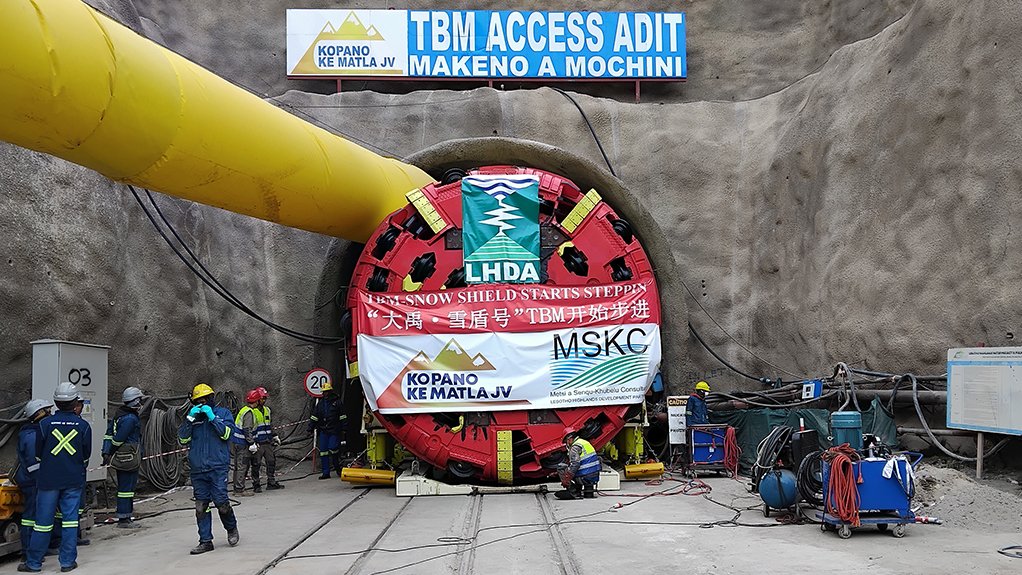


A second tunnel boring machine (TBM) is steadily drilling its way through the 38.5-km-long tunnel connecting Polihali and Katse dams, in the Maluti mountains, as the Lesotho Highlands Water Project (LHWP) Phase 2 continues.
The Polihali transfer tunnel, a gravity tunnel that will carry water from the Polihali reservoir to the Katse reservoir, is now being excavated by two TBMs simultaneously from both ends.
The new TBM is to be officially unveiled by Water and Sanitation Minister Pemmy Majodina, Deputy Minister David Mahlobo and Lesotho Minister of Natural Resources Mohlomi Moleko on Monday.
The Department of Water and Sanitation (DWS) in a statement issued on Monday described the launch of the second TBM as a powerful symbol of progress as the project transitions from preparation to full-scale tunnelling along one of the region's most ambitious water transfer routes.
The Polihali TBM, which arrived at the site in July 2025 and started excavation in January 2026, had reached 235.8 m by mid-February 2026, according to a statement by the Lesotho Highland Development Authority (LHDA).
The first TBM was launched at Katse dam in February 2025 and had been tunnel drilling at the Katse site, reaching 614.5 m by mid-January 2026.
The DWS said that the TBM measured about 423 m in length and featured a 5.38 m cutterhead and was engineered to work continuously even in the toughest underground conditions.
During this process, the machine will also install precast concrete lining segments, seamlessly transforming raw rock into a completed structure in one uninterrupted process.
Once completed, the Polihali tunnel will facilitate the transfer of significantly larger volumes of water, thereby enhancing regional water security and bolstering hydropower generation in Lesotho.
The Polihali tunnel is one of the major components of LHWP Phase 2 currently under construction.
Other components include the 165-m-high concrete-faced rockfill dam at Polihali, downstream of the confluence of the Khubelu and Senqu-Orange rivers, as well as 800-m-long Senqu bridge.
The LHDA highlighted a significant milestone in the construction of the Polihali dam: it has reached 7 756 980 cubic metres of rockfill placed, representing 53% of the total embankment volume.
At the current rate of placement of over 20 000 m3 a day, the dam continues to rise steadily toward its eventual height of 165 m above the Senqu riverbed.
The dam's crest will span 921 m and the reservoir it creates will hold a full supply storage capacity of 2 325-million cubic metres - more than twice the capacity of the Mohale dam constructed under Phase I.
Meanwhile, another landmark achievement set for later this week is the official joint launch and opening of the Senqu Bridge in Mokhotlong, by South African President Cyril Rampahosa, King Letsie III and Lesotho’s Prime Minister Samuel Matekane.
The successful completion of the Senqu bridge marks the replacement of the existing bridge, which will be submerged once the Polihali dam is impounded. The new bridge will ensure uninterrupted access to Mokhotlong, Sani Pass and surrounding areas.
Constructed at a cost of about R2.4-billion, the Senqu bridge is the largest of three major bridges being built to span the Polihali reservoir. It measures about 825 m in length and 90 m in height.
Water from the Polihali reservoir will flow through the Polihali transfer tunnel to the Katse reservoir and onward for delivery to South Africa.
External plinth construction at the main dam was 95% complete at the end of February; the intake tower base concrete was completed on February 21; and spillway excavation was 97% complete.
The dam is on track for commissioning in 2029.
Article Enquiry
Email Article
Save Article
Feedback
To advertise email advertising@creamermedia.co.za or click here
Research Reports

Projects


Latest Multimedia


Latest News

Showroom

From batteries for boats and jet skis, to batteries for cars and quad bikes, SABAT Batteries has positioned itself as the lifestyle battery of...
VISIT SHOWROOM
Design, Construction and Maintenance of Site Erected, Welded Bulk Storage Tanks for the Petrochemical, LNG, Ammonia and Sustainable fuel Sectors.
VISIT SHOWROOM


Press Office
Announcements
What's On
Subscribe to improve your user experience...
Option 1 (equivalent of R125 a month):
Receive a weekly copy of Creamer Media's Engineering News & Mining Weekly magazine
(print copy for those in South Africa and e-magazine for those outside of South Africa)
Receive daily email newsletters
Access to full search results
Access archive of magazine back copies
Access to Projects in Progress
Access to ONE Research Report of your choice in PDF format
Option 2 (equivalent of R375 a month):
All benefits from Option 1
PLUS
Access to Creamer Media's Research Channel Africa for ALL Research Reports, in PDF format, on various industrial and mining sectors
including Electricity; Water; Energy Transition; Hydrogen; Roads, Rail and Ports; Coal; Gold; Platinum; Battery Metals; etc.
Already a subscriber?
Forgotten your password?
Receive weekly copy of Creamer Media's Engineering News & Mining Weekly magazine (print copy for those in South Africa and e-magazine for those outside of South Africa)
➕
Recieve daily email newsletters
➕
Access to full search results
➕
Access archive of magazine back copies
➕
Access to Projects in Progress
➕
Access to ONE Research Report of your choice in PDF format
RESEARCH CHANNEL AFRICA
R4500 (equivalent of R375 a month)
SUBSCRIBEAll benefits from Option 1
➕
Access to Creamer Media's Research Channel Africa for ALL Research Reports on various industrial and mining sectors, in PDF format, including on:
Electricity
➕
Water
➕
Energy Transition
➕
Hydrogen
➕
Roads, Rail and Ports
➕
Coal
➕
Gold
➕
Platinum
➕
Battery Metals
➕
etc.
Receive all benefits from Option 1 or Option 2 delivered to numerous people at your company
➕
Multiple User names and Passwords for simultaneous log-ins
➕
Intranet integration access to all in your organisation